
Spiritual Poetry Is a Conversation With Infinity
A prayer can fail as language and still succeed as a human act. A poem can do the same. Spiritual poetry begins at that trembling point: where the mind wants proof, the heart wants contact, and the page refuses to pretend that existence is a simple machine.
This is not poetry with a halo glued on afterward. It is poetry that risks asking why there is anything at all. Why love arrives. Why a friend disappears. Why the stars are silent while our inner life shouts like a small universe in revolt. God may appear by name, or God may appear as absence, pressure, accident, light through a window, a word we cannot stop repeating.
The spiritual poem does not have to behave. It can doubt its own heaven. It can laugh at its own metaphysics. It can say Deus ex machina is real! and mean, perhaps, that the impossible keeps entering the ordinary without permission.
Spiritual Poetry Does Not Need Permission
Institutions often prefer spirituality when it is tidy. Put it in a recognized tradition. Give it approved vocabulary. Explain what it means before it has the chance to disturb anyone. But a living spiritual poem is not always polite enough for that arrangement.
It may be written by someone who believes and someone who cannot believe. It may contain devotion and blasphemy in the same breath. It may call God Father, Mother, Nothing, Beloved, Algorithm, Ocean, or simply You. The name changes because the encounter changes. Language is not a cage for the sacred. Language is the scar left by contact.
This is why spiritual poetry belongs as much to the restless reader as to the devout one. A reader does not need a settled theology to recognize the feeling of standing beneath a night sky and becoming briefly unimportant, then strangely responsible for everything. That contradiction is one of poetry's oldest homes.
A poem is small. Existence is not. Yet the small form can hold an enormous question without reducing it. A line break can create a silence that no lecture can manufacture. A repeated word can become a bell. A plain sentence about bread, rain, a hospital room, or a lover's hand can open into the infinite.
God Is Not Always the Subject
Spiritual poetry is sometimes mistaken for religious instruction. It can be religious, certainly, but instruction is not its first duty. Its first duty is attention.
Paying attention changes the object being seen. The cup on the table becomes more than a cup. The body becomes more than a body. A grief that seemed private reveals its ancient face. The poem does not prove that every object contains a secret message. It asks us to stay with the possibility long enough that our usual indifference begins to crack.
That crack matters. Through it come terror, wonder, memory, desire, and the recognition that nobody is fully self-made. We are given a language before we speak. We inherit names for stars, wounds, nations, sins, and kisses. We encounter other people who alter the entire direction of our lives. Call this grace if you want. Call it chance if you must. The poem remains awake either way.
The trade-off is real. Poetry that reaches too quickly for grand spiritual language can become decoration. Infinity, soul, angel, eternal, divine: these words carry power, but they have been handled so often that they can lose their heat. A serious poet earns them again through particularity.
Do not say eternity when you mean you were lonely at 3 a.m. Say the room was blue from a screen. Say you refreshed the page and nobody answered. Then, if eternity enters, it enters through the open door of the actual life.
The Sacred Can Be Rough
Not every spiritual poem is calm. Some are furious. Some accuse God. Some walk through abandonment and find no consoling voice waiting at the end. This does not make them less spiritual. It may make them more honest.
The old habit of separating sacred from profane has never held up very well. Bodies bleed. Lovers disappoint. Money controls access. Machines mediate desire. A person can have an ecstatic thought while waiting for a train or looking at a payment screen. The universe is not required to appear only in clean rooms.
The spiritual poem that survives is willing to enter this mess. It does not use transcendence as an escape from the world. It lets transcendence make the world more difficult to ignore.
Reading a Spiritual Poem Without Trying to Solve It
Many readers approach poetry as if there must be a hidden answer buried under the images. Sometimes there is a pattern to find. More often, the better question is: what has this poem changed in my attention?
Read it once for sound. Read it again for pressure. Notice what it refuses to explain. Notice where you resist it. If a line feels too strange, do not rush to correct it with analysis. Sit beside it for a minute. A poem may be obscure because it is weak, yes. But it may also be obscure because experience itself was not available in ordinary speech.
Spiritual poetry asks for this patience because its subject is often larger than statement. A poet can say, I saw God. But the phrase becomes meaningful only through the weather around it: the fear, the joke, the broken glass, the child asleep nearby, the doubt still breathing inside the sentence.
This is not an argument against clarity. Clarity is beautiful when it is earned. The point is that clarity and certainty are different things. A clear poem can admit it does not know. In fact, that admission may be its most radiant act.
The Web Can Be a Chapel, Too
Some people still imagine that serious poetry requires a printed object, a sanctioned shelf, and a gatekeeper who says this belongs. Paper remains beautiful. It asks the body to slow down. But the browser has its own strange intimacy.
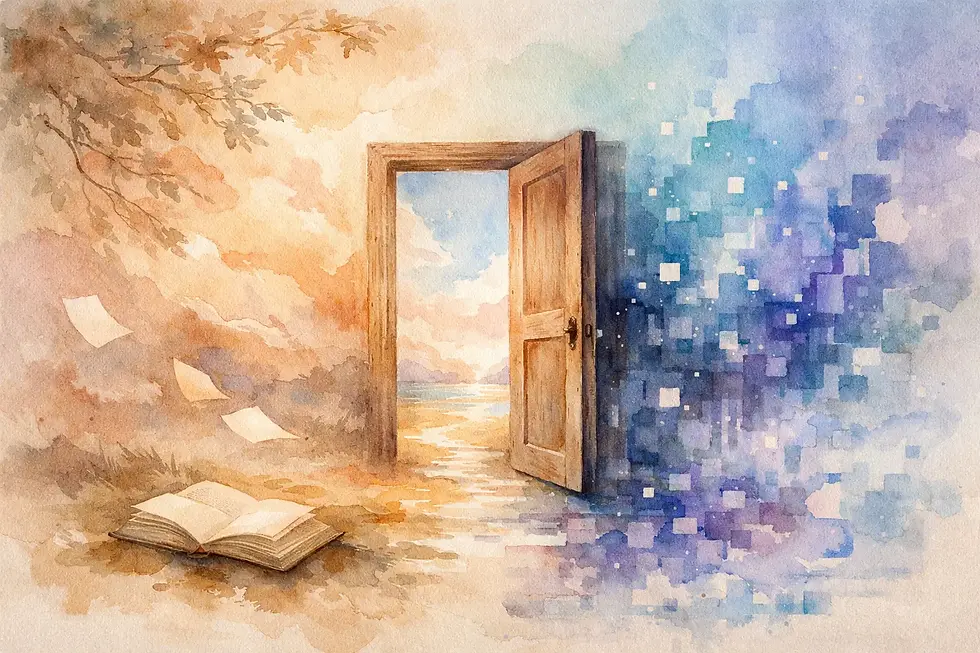
A protected digital book can be entered like a room. A password can be less a barrier than a threshold. You choose to cross. You arrive from another country, another timezone, another private midnight. The screen is not automatically shallow because it glows. It can carry confession, silence, translation, and encounter across borders that traditional publishing leaves intact.
A Hundred Poes treats the website itself as the book, which is more than a delivery choice. It is a claim: the place where you read can be part of what you read. The digital door, the access ritual, the low-cost offering, the global reach - all of it belongs to the question of who gets to meet a poem and how.
There is a trade-off here, too. A web page competes with alerts, tabs, messages, and the endless appetite of the feed. The reader must choose attention. But perhaps that choice is part of the art. The sacred has always asked for a small refusal of distraction.
Write Toward What You Cannot Own
For writers, spiritual poetry begins not with a doctrine but with a wound in knowledge. Write from the place where an answer would be convenient and none arrives. Write the strange detail you are tempted to omit. Write the question in its raw form before you turn it into a lesson.
Let your images remain physical. Let the cosmos touch the floor. If you write about God, give God a shadow, a temperature, an interruption. If you write about nothingness, let it have a sound. The reader does not need your certainty. The reader needs evidence that you were truly there when the question opened.
And do not confuse solemnity with depth. The spirit has a sense of humor. Love can be absurd. Death can make the mind notice the most ridiculous thing in the room. A poem that permits laughter may be closer to mystery than one that keeps a permanently serious face.
The work is not to capture the infinite. Nobody can. The work is to make one honest opening in language, wide enough for another person to stand beside you. Then wait. Read slowly. Let the page, or the bright little screen, become a place where the unknown is not a failure but a friend.


Comments