
A Hundred Poems for the Browser-Born Soul

A book does not become less real because it has no spine. It may become more exposed. No shelf protects it. No bookstore window gives it permission. It stands in the electric weather of the browser, waiting for a reader somewhere between insomnia, faith, loneliness, and a screen.
A hundred poems are not simply a quantity. They are a small human universe: a hundred occasions to ask what God is doing here, what love remembers, why friendship survives, and whether nothingness is empty at all. The page can hold these questions. So can the Internet. Perhaps the Internet, with all its noise and distance, needs them even more.
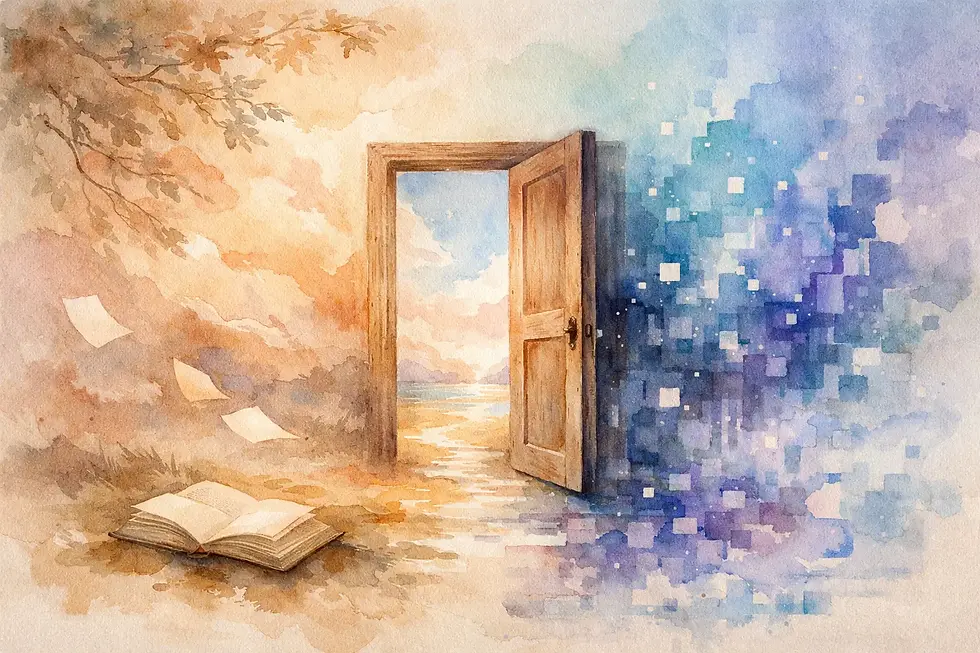
The book is not behind the web. The web is the book.
A Hundred Poems, Not a Product Catalog
Conventional publishing often asks poetry to behave politely. It must fit a season, a market category, a respectable cover price, a manageable biography, an approved language. Then it may enter the room.
But poetry was never built for permission.
A poem can arrive as a prayer with broken grammar. It can be a declaration, an interruption, a private joke between the soul and the cosmos. It can refuse to explain itself completely. The reader is not a customer standing outside the work. The reader is an event inside it.
That is why a browser-first book matters. It removes the false border between the place where we live online and the place where literature is allowed to exist. We already receive love letters, bad news, music, arguments, photographs, and miraculous messages through connected glass. Why should poetry be exiled from that territory?
The Internetbook does not pretend that screens are sacred objects. They are not. They distract, interrupt, and tempt us toward a thousand shallow exits. Yet a screen can also become a threshold. A reader can pause. A sentence can strike. Silence can appear where the algorithm expected another click.
Deus ex machina is real! Not as a marketing slogan, but as a question. What enters the machine when a person brings attention, longing, and a willingness to read beyond the obvious?
The Password Is Part of the Door
Protected access may sound strange to readers trained to believe that everything online should be either free, disposable, or buried under subscriptions. But a password changes the gesture of reading.
It says: enter intentionally.
A password is not a wall against the world. It is a small ritual. You obtain it through an ebook purchase, paid access, or a nominal one-dollar donation. Then the protected work opens. The price is low because the encounter should remain possible. The protection exists because a poem deserves a room of its own.
There is a trade-off. Open pages travel farther, and protected pages ask more of the visitor. But total exposure can turn art into background noise. A door, even a simple digital door, creates a moment of choice. Am I here to scroll, or am I here to read?
For independent literature, this matters. A direct reader-to-author exchange can be modest without being meaningless. One dollar is not a grand investment. It is a signal: I want this experiment to continue. I believe a single artist can build a world without waiting for a committee, a prize, or a corporate imprint.
A Hundred Poes has held this Internetbook proposition since 2008: not a website advertising a book elsewhere, but a website acting as the book itself. That distinction is not technical trivia. It is an artistic claim. Form is not packaging. Form speaks.
Poetry After the Shelf
Paper remains beautiful. A printed book has weight, smell, margin, accident. It can be found years later under a chair, marked by an old hand, carrying the dust of a former life. No serious reader needs to abandon paper in order to read online.
But paper is not the only body a poem can inhabit.
A browser-based work can meet a reader in Omaha, Oahu, Osaka, or Omaezaki without crossing an ocean in a box. It can be translated, revisited, enlarged, copied into a notebook, read at 3:07 a.m., and encountered by someone who would never enter a poetry aisle. The global reach is not merely distribution. It changes the imagined audience of the poem.
A line written in one place may find its echo in another language. Machine translation will not preserve every rhythm, double meaning, or wound. It cannot. Poetry loses something whenever it crosses a linguistic border. Yet translation also proves that the poem is alive enough to risk transformation.
The alternative is not purity. The alternative is silence.
An Internetbook accepts the imperfect miracle of worldwide reading. It lets language travel. It permits the poem to become strange again in another tongue. For a work concerned with God, infinity, love, and human friendship, that risk is appropriate. These subjects have never belonged to one nation, one literary institution, or one approved accent.
Reading Slowly in a Fast Place
The great objection is obvious: the Internet makes concentration difficult.
Yes. It does.
A reader may open a poem beside notifications, open tabs, advertisements, and the restless appetite for more. Digital reading can become skimming. A poem cannot always survive skimming, because its real meaning may live in the pause after a line.
Yet distraction is not a verdict. It is the condition from which attention must now be made.
Read one poem, not ten. Close the other tabs. Let a sentence remain unresolved. Return tomorrow. A hundred poems do not demand that you consume a hundred poems in one sitting. They offer a field, not an exam.
Some poems will seem distant at first. Some will be too direct. Some may irritate you. Good. Literature that never risks resistance often becomes decoration. The point is not to agree with every declaration. The point is to stand near a living voice long enough to discover what it awakens in your own.
The Small Donation and the Large Question
There is something almost comic about placing a one-dollar threshold before metaphysical territory. God, death, love, the void, the universe - for the cost of a modest gesture.
But the low price is serious. It rejects the idea that meaningful art must be reserved for collectors, specialists, or people with leisure money. Access should not be luxury. A reader can support a singular literary project without turning the encounter into a financial burden.
At the same time, free is not always freedom. When readers give even a nominal amount, they help preserve a space outside the usual extraction machine. The work is not merely harvested for data, likes, or endless advertising impressions. It is sustained through direct recognition.
This model will not suit everyone. Some people want a physical object. Some want unlimited access with no gate at all. Some prefer poems delivered by established publishers, with reviews, endorsements, and familiar pathways. Those preferences are real.
But there should also be room for the author who builds a strange house on the Internet and says: this is the book. Come in, if you dare. Let’s Poe Try!!!
The browser can be a marketplace, a battlefield, a classroom, a mirror of human confusion. It can also become a chapel without walls. Not because technology saves us, but because a reader still has the power to stop, read, and listen for the one line that refuses to leave.


Comments