
Experimental Poetry Is a Living Web of Risk
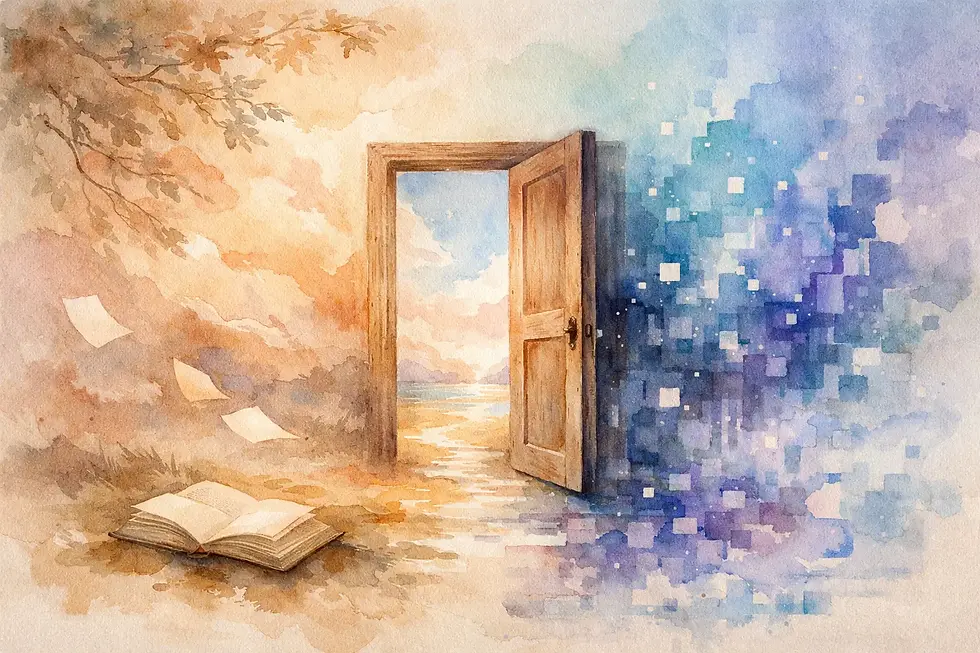
A poem does not have to sit quietly on a white page, waiting for permission from a bookstore. It can appear behind a password. It can interrupt a screen. It can arrive translated, imperfectly, from one human weather system to another. Experimental poetry begins there: where the poem refuses its assigned furniture.
This is not rebellion for decoration. A broken line is not automatically free. Strange typography is not automatically revelation. The experiment matters when form changes the pressure of thought - when a reader cannot continue on autopilot because language has become a living question.
God may be inside that question. So may nothingness, friendship, lust, a city at 3 a.m., a machine that mistranslates the word love and accidentally creates a new prayer. Deus ex machina is real! Not because the machine replaces the soul, but because the soul has always used every available instrument to call into the dark.
What Experimental Poetry Actually Experiments With
Experimental poetry is not one school, one costume, or one secret club for people who enjoy being confused. It is poetry that tests the conditions of poetry itself. What counts as a line? Who speaks? Does meaning live in grammar, sound, arrangement, code, repetition, silence, or the reader's own movement through a text?
A conventional lyric may give us a speaker, an image, a turn, and a final note that gathers the feeling. An experimental poem may scatter those elements across fragments, borrowed voices, visual fields, hyperlinks, corrupted language, documents, code, images, or empty space. It may withhold the familiar handrail. That can feel ecstatic. It can also feel cold. Both responses are honest data.
The point is not to make reading difficult as a test of social rank. The point is to expose habits that have become invisible. We are trained to expect language to deliver information cleanly, quickly, obediently. Poetry can ask: obedient to whom? Clean for what? Quick enough to avoid feeling?
Experimental work often gives the reader a job. Not homework. A job of attention. You may have to reread a phrase, hear a word in two languages, notice a gap, or accept that a poem is not a locked box with one correct key. Meaning may be made between the work and the person encountering it. This is intimate labor.
Form Is Not a Container
In ordinary publishing, form is often treated as packaging. First comes the text, then comes the page, the file, the cover, the sales channel. But experimental poetry can make the container speak. A browser page can be a room. A password can create a threshold. A scroll can become duration. A translation button can reveal how unstable the supposed original was all along.
That does not mean every digital poem needs animation, sound, or visual fireworks. Technology can enlarge a poem, but it can also bury it beneath spectacle. If the moving image says nothing the language could not say, it is only movement. If the interaction deepens uncertainty, memory, desire, or presence, then the form has become part of the poem's body.
The Internetbook is one such possibility. It treats the site not as a cashier standing outside literature, but as literature's location. The reader enters the work rather than downloading a replica of a printed object. This is not a rejection of paper. Paper has gravity, patience, and a beautiful refusal to notify. But a browser has its own metaphysics: access, distance, repetition, disappearance, global simultaneity.
Experimental Poetry and the Right to Be Unfinished
The polished poem often arrives with its shoes tied. Experimental poetry may arrive barefoot, carrying conflicting documents, changing its mind halfway through the sentence. Its unfinished quality can be its truth.
Life does not present itself in clean stanzas. A person receives a message, remembers a childhood room, worries about rent, sees the moon between buildings, and tries to pray without knowing to whom. The mind cuts, loops, deletes, invents. A poem that acknowledges this fractured motion may be more accurate than one that pretends consciousness is a neat hallway.
Still, unfinished does not mean careless. There is a difference between productive uncertainty and mere vagueness. A strong experimental poem creates a field of force. Even if readers cannot paraphrase it, they can feel its decisions: a repeated phrase that gains menace, a sudden blank that becomes grief, a bureaucratic sentence placed beside a confession until both become absurd.
The useful question is not, “Do I understand every part?” Ask instead: “What is this poem making possible that a straightforward statement could not?” Sometimes the answer is sound. Sometimes it is permission. Sometimes it is a silence that remains after the screen goes dark.
Difficulty Can Be an Invitation, Not a Wall
Experimental work has a reputation for excluding people. Sometimes that reputation is deserved. An artist can mistake obscurity for depth, or build a private language with no door in it. Readers do not owe a poem infinite patience simply because it calls itself radical.
But immediate clarity is not the only kind of generosity. A poem can respect its reader enough to leave room for discovery. It can resist being consumed in ten seconds. It can ask for a second encounter, then a third, until a phrase opens differently because the reader has changed.
Approach it without trying to win. Read aloud, even if the syntax seems strange. Follow the visual arrangement before hunting for a message. Notice recurring words. Let an unfamiliar phrase remain unfamiliar for a while. Translation can help, especially across languages, but it also introduces fresh distortions. Those distortions are not always failures. They may show that no word reaches another person untouched.
This is where digital access becomes unusually powerful. A poem can travel from a solitary author to a reader across an ocean for almost nothing. It can be revisited at midnight. It can meet machine translation and emerge bruised, altered, still alive. The web does not make literature universal by magic. It does make contact more possible.
The Poem Is Not a Product That Must Behave
Commercial culture prefers works that announce their category, explain their usefulness, and finish before attention wanders. Poetry has never entirely agreed. Experimental poetry makes that disagreement visible.
It may fail. Let us say it plainly! Some experiments produce noise, vanity, dead air, or an idea that should have stayed in a notebook. Risk includes failure. Yet conventional safety fails too: another polished poem saying what has already been said in the approved voice, with no danger to its author or reader.
The better wager is not that every strange poem is brilliant. The better wager is that literature needs places where strangeness can be tested without asking a gatekeeper to certify its humanity first. A direct-to-reader project such as A Hundred Poes belongs to that wager. A low-cost threshold, a protected text, a browser as book: these are not merely delivery choices. They declare that authorship can build its own door.
There is an ethical dimension here. When writers control how their work reaches people, they can preserve oddness that a conventional market might sand down. Yet independence has trade-offs. Without editors, communities, and critical conversation, a writer can become trapped inside a private echo. Freedom needs encounter. The poem needs resistance from real readers, not just applause from its own mirror.
Read for the Shock of Recognition
The most radical experimental poem is not necessarily the one with the most fragments, code, or typographic acrobatics. It may be the one that returns language to danger. It makes a familiar word - God, body, America, mother, zero, friend - feel newly unstable. It lets us recognize something we knew but had not yet been able to say.
Read slowly when the poem asks for slowness. Leave when it offers nothing but pose. Return when a line keeps tapping at the inside of your skull. Support work that takes real risks, even when the risk is imperfect. A dollar, a password, a moment of undivided attention: small acts can keep an independent literary universe breathing.
Let the poem be weird. Let it be tender. Let it fail in public and begin again. Somewhere between the screen, the silence, and the person reading, a new language may already be trying to speak. Let’s Poe Try!!!


Comments