
How to Find Contemplative Poetry That Stays
A poem does not become contemplative because it says “silence” three times, places a moon in the first stanza, or gives God a capital G. Some poems are beautifully quiet and yet leave nothing open inside you. Others arrive like a wire from the unknown. If you are asking how to find contemplative poetry, begin there: look for language that does not merely decorate the mystery, but permits you to stand before it.
Contemplative poetry is not an escape from thought. It is thought brought to its edge, where explanation gives way to attention. It can be religious, agnostic, ecstatic, wounded, erotic, skeptical, or almost plainspoken. Its central act is not preaching. It is making room.
What Contemplative Poetry Actually Asks of You
A contemplative poem slows the reader without issuing an order to slow down. It may hold a single image for longer than expected: a hand on a table, the rain against a window, an empty train platform, a name that cannot be recovered. It may ask about death, friendship, love, nothingness, the body, or God. But its subject is never enough by itself.
The difference is in the pressure of attention. A poem about a cathedral is not necessarily contemplative. A poem about an ordinary glass of water can be, if the glass becomes a meeting point between the visible fact and the invisible question.
This is why contemplative poetry can feel demanding. It does not always deliver a quick opinion, a tidy moral, or a clever final turn. It gives you a space in which your own mind becomes audible. For some readers, that space feels like prayer. For others, it feels like an honest encounter with uncertainty. Both are welcome at the same threshold.
How to Find Contemplative Poetry Beyond the Usual Shelves
Start by changing the question from “Which poets are contemplative?” to “What happens to me while I read this?” Names and traditions can help, but no label can do the reading for you. A poem may be filed under spiritual writing, nature writing, mysticism, experimental poetry, or literary fiction and still carry the contemplative charge you are seeking.
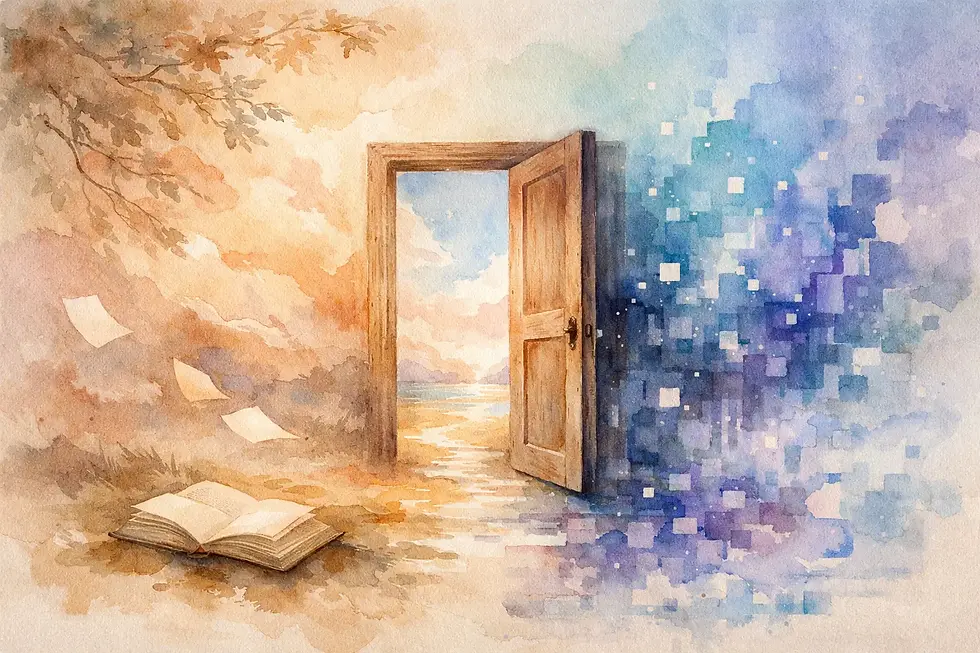
Look in places where poets are permitted to be difficult, intimate, and unmarketable. Small digital publications, author-run archives, independent presses, translated collections, and browser-based books often contain work that larger systems overlook. The Internet is full of noise, yes. It is also full of doors that a conventional bookstore cannot build.
Search with combinations that describe your actual hunger. Try terms such as contemplative poems on grief, poems about God and absence, mystical experimental poetry, poems on solitude, or poetry about infinity and the body. Then follow the language, not the algorithm. If one poem gives you a strange interior pause, read the poet’s other work. Read the acknowledgments. Read who they translate, quote, resist, and love.
Translation deserves special attention. Contemplative poetry has traveled for centuries across languages, religions, and geographies because silence is not owned by one nation. A translated poem may feel slightly unfamiliar in English. That slightness can be a gift. It interrupts your habits of reading and lets the poem remain partly foreign, partly beyond possession.
Do not mistake obscurity for depth, though. A poem can be fragmented, abstract, or full of cosmic vocabulary and still be empty. Mystery is not the same thing as vagueness. The best difficult poems make you feel that something precise has occurred, even when you cannot immediately paraphrase it.
Follow Forms That Allow Silence
Certain forms are especially hospitable to contemplation, but none guarantees it. Short lyric poems can create a concentrated flash of awareness. Long sequences can return to the same question until repetition becomes revelation. Prose poems can resemble meditations, dreams, or messages left by an unknown friend.
Fragments are worth seeking out as well. A fragment does not always mean an unfinished thought. Sometimes it is the only honest shape for an encounter with the infinite. The mind receives a small piece. The rest remains unspoken. Deus ex machina is real! Or perhaps the machine is only a mirror, and God is the interruption inside the code.
Read poems that use spare language, but also read poems that overflow. Contemplation is not always minimal. Some writers reach silence through abundance: catalogs, incantations, repeated invocations, collisions between the sacred and the ordinary. A poem may whirl before it becomes still.
Read Slowly Enough to Notice the Door
Finding the poem is only half the work. The other half is allowing it to happen. Read a poem once without stopping. Then read it again aloud, even quietly. The ear catches what the scanning eye ignores: repetitions, held breaths, hard consonants, sudden softness, a line break that changes the meaning of a sentence.
Afterward, resist the urge to explain it immediately. Sit with one image or line. Ask what it refuses to resolve. Ask what kind of silence it creates: comfort, terror, awe, loneliness, recognition. If nothing happens at first, do not force a spiritual event. Some poems need time. Some are simply not for you. That is not failure. It is discernment.
Keeping a small reading notebook helps, especially if you are moving through online work. Do not write a school-style interpretation. Copy a line that stays with you, then record the physical response it caused. Did your breathing change? Did you remember someone? Did you feel resistance? Contemplation begins in attention, and attention leaves traces.
A useful test is to return after a day or a week. A contemplative poem often grows stranger with distance. Its language may reappear while you wash dishes, walk home, wait for a message, or wake in the dark. It does not demand to be admired. It continues its work underground.
Build a Reading Practice, Not a Trophy Shelf
There is a trap in collecting spiritual or contemplative books as proof of seriousness. A shelf can become a costume. Read fewer poems more than once. Let a single poem accompany you for several days. You do not need a perfect room, expensive edition, special candle, or institutional permission to read with depth.
A browser can be a chapel if you enter it differently. Close the extra tabs. Turn off the small alarms that insist the world cannot continue without your reaction. Read one protected page, one digital chapbook, one poem sent directly by an independent author. The medium is not automatically shallow because it glows. A screen can hold a threshold.
This matters for readers who want literature outside the gates of conventional publishing. Direct-to-reader poetry changes the encounter. You may not be choosing from a cultural menu designed by committees and sales forecasts. You may be entering an author’s constructed universe, with its own passwords, errors, prayers, provocations, and private cosmology.
A Hundred Poes belongs to that possibility: the website as book, the book as an ongoing experiment, access made deliberately small enough to invite risk. A nominal act of support can become a literary crossing. Not because payment makes a poem sacred, but because choosing to enter changes the quality of attention. Let’s Poe Try!!!
Know the Difference Between Solitude and Isolation
Contemplative poetry frequently leads you inward, but it should not make the world disappear. The deepest inward poems often sharpen your relation to other people. They make a stranger more real. They complicate an enemy. They remind you that love is not sentimental agreement but a difficult form of seeing.
Be cautious of work that uses spiritual language to avoid pain, history, or responsibility. Not every poem needs to address public catastrophe directly. But contemplation that never risks contact with another life can become self-enclosure. A poem may be quiet and still carry the whole human weather inside it.
The poems worth finding do not always make you peaceful. Sometimes they make peace impossible for a while, because they reveal what you have ignored. They may leave you with grief, desire, reverence, or a question that cannot be monetized, solved, or posted as a neat answer.
Read one tonight without asking it to improve you. Give it five unclaimed minutes. If a line remains after the page closes, let it remain. That small persistence may be the beginning of the conversation you came looking for.


Comments